Pflugerville & the Northeast Austin Suburbs
Catch Basins & Channel Drains
Catch basins and channel drains collect water that sits or sheets across the surface and send it into buried pipe. They suit low spots, patios, driveways, and the foot of a slope where grading alone cannot do the job. This page explains how each one works, how to choose between them, and what matters in the clay-soil suburbs near Austin.
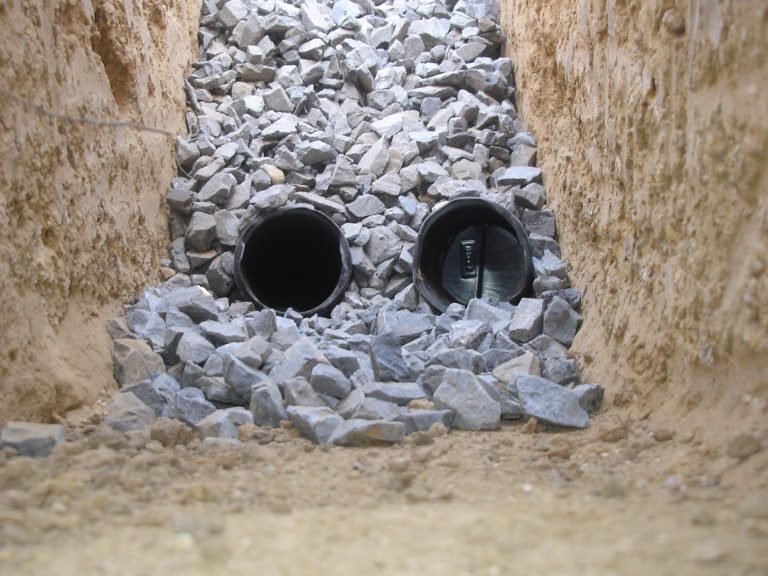
A catch basin is a box, usually plastic or concrete, set into the ground with an open grate on top. Water flows across the lawn, drops through the grate, and falls into the box. A pipe attached near the bottom carries it away. Many basins also have a sump, a few inches of empty space below the outlet pipe, where sand, leaves, and silt settle out instead of traveling down the line and clogging it. Catch basins are the right tool for a single low spot, such as the lowest corner of a back yard, where runoff gathers and has no natural way to leave. They are a point solution rather than a long-line one. Basins usually come in nine, twelve, and eighteen inch sizes, and the grate is chosen to match the amount of water headed its way.
A channel drain, sometimes called a trench drain, does the same job in a long, narrow strip. It is a shallow trough with a grate on top, set flush with the surface so water running across a patio, driveway apron, or garage threshold drops into it before it reaches the house. Channel drains come in widths from a few inches to ten or twelve inches, with plastic or metal grates built for foot traffic or, in heavier-duty versions, vehicle loads. Because they run in a line, they intercept sheet flow across a whole width, which a single basin cannot do. This makes them especially useful where a slab slopes toward a door. Slotted and bar grates differ in how much water they pass, so the grate type matters as much as the trough underneath it.
Both devices are only as good as the pipe and outlet behind them. A grate can pass hundreds of gallons a minute in a heavy rain, but if the pipe beneath is undersized, flat, or blocked, water backs up and floods the area the drain was meant to protect. That is why installers size the pipe to the area draining into it, set it on a steady slope, and make sure the discharge point can handle the flow. Typical outlets are the same as for other drains: a lower part of your lot, a pop-up emitter, a dry well, or a municipal connection where one is permitted. Always confirm the outlet is legal and safe before the first shovel hits the soil.
In clay soil, surface drains matter for a simple reason. The Blackland Prairie clay east of I-35 absorbs water slowly, so rain often runs across the surface instead of soaking in. Compacted construction fill around new homes makes this worse, because it behaves almost like pavement when it is wet. That means a patio, a side yard, or the low end of a sloped lawn can collect large volumes of water in minutes. A catch basin or channel drain catches this runoff quickly, before it saturates the soil along the slab, and it can do so without trenching up the whole yard like a long French drain might. Pairing the basin with a corrected slope keeps the water moving into the grate instead of around it.
Choosing between a basin, a channel drain, and other options starts with where the water comes from. If you have a single bowl-shaped low spot, a catch basin is often enough. If water runs across a hard surface, toward a garage door or a patio threshold, a channel drain across the path is typically the better choice. If water is seeping up from wet soil, not running over it, a French drain is the better answer. Many yards need two or three of these working together, with the surface drains tied into the same buried pipe network, and the whole plan designed so every piece has somewhere to send its water. Walking the yard in a rainstorm, with a phone camera, is the easiest way to see which type fits.
Maintenance is where most failures start, and it is easy to prevent. Grates collect leaves, mulch, and toys, and a clogged grate stops catching water. A basin's sump fills with silt and needs to be scooped out once or twice a year, and more often under trees. Sediment is the biggest threat in clay country, because fine clay washes into the box and settles as hard cake. Check with your city or HOA before tying a drain to a street inlet or an easement, and call Texas811 at least two business days before any digging. A simple spring and fall cleaning routine keeps the system working at full capacity for years. Grates that are bolted or locked also keep children and pets from lifting them.
Signs you may need catch basins & channel drains
- A low spot in the lawn that holds water after every rain
- Water running across a patio or driveway toward a door or garage
- Puddles at the end of a swale or against a fence line
- Mud, sediment, or sand washing across hard surfaces
- An existing drain grate that overflows or stays full
- Wet or stained concrete at the base of a wall
- Ponding at the bottom of a sloped yard after short storms
Catch Basins & Channel Drains on clay-soil lots
Newer subdivisions in Pflugerville, Hutto, and Manor often have lots graded with shallow swales and compacted fill that sheds water fast. A catch basin at the low corner of a fenced yard can be the missing piece when a swale ends at a fence and the water has nowhere to go.
Patios and driveways poured on clay can settle or tilt slightly over time, sending water toward a door or garage. A channel drain at the threshold is a quick, low-profile way to protect the entry while you decide whether the slab itself needs leveling or sealing.
Silt is the enemy here. Blackland clay washes into drains and sets up like cement. Sumps, grates with fine openings, and regular cleaning are especially important in this region. Skipping the sump is a common cost-saving shortcut that causes clogs within a year or two.
Lots near Gilleland Creek, Brushy Creek, and Wilbarger Creek may include drainage easements, and some are in mapped floodplains. Do not tie a new drain into a creek bank or channel without city approval. Check with your city before any work in an easement.
Hard Texas downpours can overwhelm small grates in minutes, and fall leaves from live oaks and pecans clog them fast. A larger grate area, a nearby overflow path across the lawn, and a rinse after leaf drop help the system cope with the big storms that Central Texas gets every year.
Our catch basins & channel drains process
- 01
Find the low spots and flow paths
We watch how water moves across your lot during or after rain, marking where it collects, where it crosses hard surfaces, and where it should leave. We also check the existing slope of patios and drives. This tells us whether a basin, a channel drain, or both are the right tools for your yard.
- 02
Size the system to the water
We estimate how much roof, paving, and lawn drains toward each point, then choose a grate size and pipe diameter that can handle it. Four-inch pipe works for many small yards, while larger areas call for six-inch. Sizing too small is the most common reason a drain overflows in a hard rain.
- 03
Call 811 and plan the outlet
Texas law requires a call to 811 at least two business days before digging, not counting weekends and holidays. We then confirm the outlet: a lower part of your lot, a pop-up emitter, a dry well, or an approved street connection. City and HOA rules differ, so we check before any trenching begins.
- 04
Excavate and set the basin or channel
The hole or trench is dug to the depth needed, and the base is leveled on compacted gravel so the unit does not settle. The grate is set slightly below the surrounding grade so water flows into it. Channel drains are set to a gentle slope, and they are anchored with concrete when they sit in a slab.
- 05
Connect solid pipe and add cleanouts
Solid pipe leaves the basin or channel and runs downhill to the outlet, joined with proper fittings and sealed at the connection. Cleanouts are added at turns so the line can be flushed. We run water into the system before backfill to check for leaks, standing water in the pipe, and the speed of flow.
- 06
Backfill, finish, and show you the upkeep
The trench is backfilled in layers, the surface is graded to feed water into the grate, and sod or concrete is restored. We then show you how to remove the grate, check the sump, and clear debris, so you know exactly what a simple spring and fall cleaning looks like. Ask to see it done once.
What affects the cost of catch basins & channel drains
Number and size of drains
One small catch basin in a back corner is a modest project. A long channel drain across a driveway apron, plus a basin or two, adds up quickly. Wider channels and heavy-duty grates for vehicle loads cost more than light-duty versions. Market prices vary widely, so any number you find online is only a ballpark and not a quote.
Cutting into concrete
Installing a channel drain in an existing driveway or patio means saw cutting, breaking out concrete, setting the drain, and pouring back new concrete. Slab work adds labor, curing time, and a visible patch. A drain placed in soil at the edge of a patio costs less than one placed in the middle of it.
Pipe run and outlet
The longer the pipe has to run to reach a legal outlet, the more it costs in materials, digging, and restoration. A pop-up emitter at the edge of the lawn is simpler than a dry well or a long run to a street connection. Outlet rules vary by city, so confirm what is allowed early.
Soil, rock, and roots
Hard, dry clay in summer and shallow limestone west of I-35 both slow digging. Tree roots complicate trenching and may require hand work or rerouting. Wet conditions can delay the work and require extra gravel for a stable base. Site conditions are the main reason two quotes for similar jobs can differ. Ask what depth is assumed in the estimate.
Landscaping and finish
Replacing sod, rebuilding a section of flagstone, or matching a stamped concrete finish adds cost. Decorative grates and custom finishes are a choice, not a need, and standard grates work well. Asking for the finish work to be itemized lets you decide which pieces are worth the extra spend. Ask for the grate style up front.
Catch Basins & Channel Drains FAQs
What is the difference between a catch basin and a channel drain?
A catch basin is a box with a grate that collects water at a single point, like the lowest corner of a yard. A channel drain is a long, narrow trough that catches water along a line, such as across a patio or driveway. Basins suit low spots, and channel drains suit water crossing a hard surface in a wide sheet. Many yards use one of each.
Where does the water from a catch basin go?
It travels through buried solid pipe to an outlet. Common outlets are a lower part of your own lot, a pop-up emitter, a dry well, or a street connection where your city allows it. Texas Water Code Section 11.086 prohibits diverting surface water in a way that damages a neighbor's property, so the outlet must be chosen with care. A site visit confirms the exit before work starts.
Will a channel drain stop water from entering my garage?
Often, yes, when the water runs across the driveway toward the door. A channel drain set across the slab intercepts the flow before it reaches the threshold. It must be sized for the volume of water and connected to a working outlet. If water seeps up through cracks, or the slab slopes strongly toward the door, additional fixes may be needed. A site visit shows which case applies.
How often do catch basins need cleaning?
Check them at least twice a year, in spring and fall, and after big storms. Remove the grate, scoop out silt and leaves from the sump, and flush the pipe with a hose. Under trees or in clay-heavy yards, you may need to clean more often. A basin that is never cleaned will eventually stop working. Fine clay silt hardens, so clean it while it is soft.
Do I need to call 811 before installing a drain?
Yes. Texas law requires anyone who digs, including homeowners, to notify Texas811 at least two business days in advance, excluding weekends and holidays. Public utilities mark their lines for free. Private lines such as irrigation or lighting wiring usually are not marked, so tell the crew about anything you know is buried. Call early so your start date is not delayed.
Can a drain be installed in existing concrete?
Yes, but it takes more work. The slab is saw cut, the concrete removed, the drain set at the correct slope, and new concrete poured around it. The patch is visible, and it needs time to cure. When possible, placing the drain at the edge of the slab in soil reduces cost and keeps the original surface intact. Ask how the patch will look.
Are these drains a fix for foundation problems?
They help protect a foundation by removing surface water near the slab, which evens out soil moisture on expansive clay. They do not repair a foundation that has already moved. If you see widening cracks, doors that stick, or uneven floors, a structural engineer or foundation repair company should evaluate the house. Drainage and structural repair are separate jobs. Keep the grate clear.
Do I need city or HOA approval for a new drain?
It depends on where you live and what you are connecting to. Work in a drainage easement, a connection to a street inlet, or a visible change to the yard may need approval. Rules vary by city and HOA, so check with your city or HOA first, and keep any approval in writing for your records. Photos of the planned route help the review.
Catch Basins & Channel Drains near you
- Catch Basins & Channel Drains in Pflugerville
- Catch Basins & Channel Drains in Round Rock
- Catch Basins & Channel Drains in Hutto
- Catch Basins & Channel Drains in Manor
- Catch Basins & Channel Drains in Georgetown
- Catch Basins & Channel Drains in Taylor
- Catch Basins & Channel Drains in Elgin
- Catch Basins & Channel Drains in Wells Branch
- Catch Basins & Channel Drains in Northeast Austin
- Catch Basins & Channel Drains in Brushy Creek
- Catch Basins & Channel Drains in Cedar Park
- Catch Basins & Channel Drains in Leander
Water pooling or concrete sinking?
Call or send a request. We will look at where the water goes, check the grade and give you a written estimate.