Wells Branch · Travis and Williamson Counties
Dry Wells & Pop-Up Emitters in Wells Branch, TX
Dry wells work best where the soil can accept water. In Wells Branch, clay can slow absorption, and rock near the surface can limit digging. A dry well needs a drain test, adequate size and an overflow route. When the site does not suit one, a pop-up emitter that discharges safely onto the lot is usually simpler. Ask to see the drain test results before you agree to one.
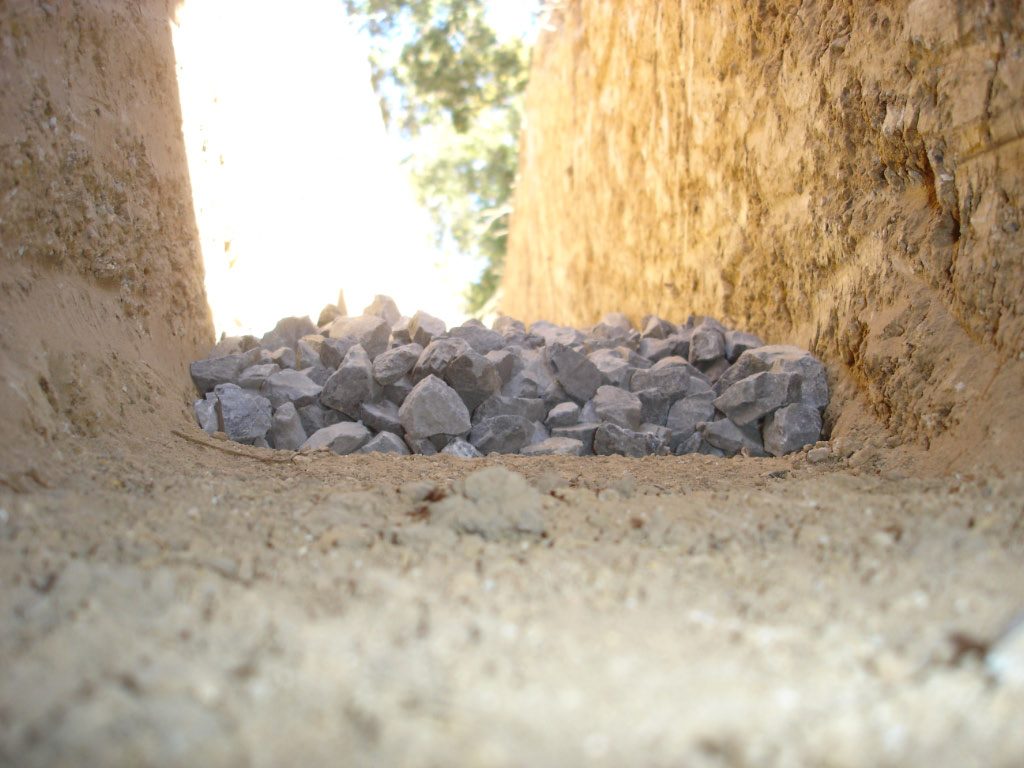
Dry Wells & Pop-Up Emitters for Wells Branch homes
Small lots make dry wells attractive, since they hide underground and take little space. The question in Wells Branch is whether the soil can take the water. Close to the I-35 transition, soils can be limestone-influenced on one lot and dense clay on the next. Where clay dominates, a dry well drains slowly and may stay full for days after a heavy storm. Where there is fractured limestone or sandy loam, it can work very well. If a soak test passes, the well design is straightforward. A hole about four feet across and four to five feet deep, lined with fabric and filled with washed stone or plastic storage crates, handles one or two downspouts. The pipe enters near the top, and a screen at the inlet keeps leaves out. Over time, the stone or crates give the water a place to wait while it soaks away.
A simple soak test tells you more than a guess. Dig a hole about a foot wide and two feet deep, fill it with water, and time how far it drops in an hour. A fast drop suggests that a dry well would work. A slow one means the well must be larger, or you need a different approach such as a pop-up emitter that spreads water across a lawn or a drain that reaches the street. Soil layers matter as much as the surface soil. A clay cap over limestone may drain well once the water passes the clay, while a thick clay layer holds it. Digging a test hole to the depth of the planned well shows what you have. Shallow rock can also stop a hole short, which changes the design or rules out a well entirely, and rock breaking costs extra.
Placement is the key rule on a compact lot. A dry well should sit well away from the foundation, at least 10 feet and more when possible, and away from neighboring property lines, fences and trees. Gas, water and electric lines in side yards limit where you can dig, so a locate through 811 comes first. Ask your association and the MUD about rules for buried structures. Overflow needs a path as well, since a full well should spill onto your own yard, not a neighbor's. Pop-up emitters need only a trench and a pipe, so they cost less and avoid the soak question. The trade-off is that they discharge on the surface, which can create a damp patch on the lawn. In a small yard, direct the emitter along the back fence in a spot that slopes down and has grass. Keep it clear of trails and neighbors' gates.
What to know in Wells Branch
Limited space for setbacks
On a 6,000-square-foot lot, finding 10 feet from the slab, 5 feet from fences and a clear path from utilities is a puzzle. Sometimes only one corner works. If none does, a pop-up emitter or a surface drain may be a better fit than forcing a well into a spot that is too close.
Groundwater and neighbors
Water released into the soil can travel underground and show up in a neighbor's yard or garage. Keeping the well away from property lines and designing it for modest volumes helps. If a neighbor complains about wet ground, a well too close to the line can be the cause.
Storage volume over soak speed
In slower clay, the well's job is to store water until it can soak away. Plastic crate systems provide more storage per cubic foot than gravel alone. Sizing for a full storm from your roof section, not just a few gallons, is the difference between a well that works and one that overflows.
Signs you may need dry wells & pop-up emitters
- A downspout or drain pipe with no clear place to send its water
- Water pooling at the end of a pipe or splash block
- Eroded soil or a washed-out patch where a pipe discharges
- An existing dry well or pit that stays full for days after rain
How dry wells & pop-up emitters works
A pop-up emitter works very differently. It is a small fitting, often with a hinged or spring-loaded cap, sitting flush with the lawn at the end of a buried pipe. When water flows through the pipe, pressure pushes the cap open and the water spills onto the surface. When the flow stops, the cap drops back and closes, which keeps out mowers, insects, and small animals. An emitter does not store anything, and it does not rely on soil absorption. Its job is to release water over a wide patch of lawn, which spreads the flow out and reduces erosion compared with a bare pipe end. It needs a slope that carries the water away from the house. Emitters are also easy to inspect, since you can see them and lift the cap to check for debris.
The soil is the deciding factor, and here is where honesty matters. Dry wells depend on soil that drains. Sandy and gravelly soils accept water quickly, and a dry well works well in them. Heavy clay, such as the Houston Black soils of the Blackland Prairie east of I-35, absorbs water very slowly, because the particles are tiny and the soil swells shut when wet. A dry well in tight clay can fill and stay full for days, which defeats its purpose. Before one is recommended on a clay lot, a simple percolation test, in which a hole is filled with water and the drop is timed, shows whether the soil can accept the volume. Ask any installer for the test result, not only a recommendation.
What to expect on a Wells Branch visit
- 01
Decide whether the soil can take it
We dig a test hole where the dry well would go, fill it with water, and time how fast it drops. Slow results in clay tell us a dry well will not drain, and we recommend an emitter or daylight outlet instead. This one step prevents the most common and costly dry well failures. Results are shared with you.
- 02
Choose the outlet type and location
Based on the soil, slope, and lot size, we pick a dry well, a pop-up emitter, or a combination. We place the outlet well inside your property, away from the foundation, septic components, and neighbors, and we plan a clear overflow route across your own lawn for very heavy storms. We mark the plan on a sketch for you.
- 03
Call 811 and mark the work area
Texas law requires a call to 811 at least two business days before digging, excluding weekends and holidays. Public utilities mark their lines for free. We also paint the pipe route and well location, and we check for private irrigation lines and tree roots that could change the layout. We also confirm how deep the line sits.
- 04
Excavate and build the structure
For a dry well, we dig the pit, line it with filter fabric, and set a perforated chamber or fill it with washed stone. For an emitter, we trench the pipe on a steady downhill slope and set the fitting flush with the lawn. All connections are sealed and bedded on compacted material.
- 05
Connect inflow and add overflow protection
Pipes from downspouts or drains enter the top of the well or the start of the emitter line. A dry well gets an overflow pipe or a surface path in case it fills. We add cleanouts and, where useful, a small silt-catching basin ahead of the well to protect it. Everything is labeled on the sketch.
- 06
Test, backfill, and explain the upkeep
We run water through the whole system, check the speed of the outlet, and watch for leaks. Then we backfill in layers, restore the lawn, and show you how to check the emitter cap, clear debris, and tell if a well is draining or staying full after storms. You get a simple sketch of the finished layout.
Our approach in Wells Branch
- We walk the property in Wells Branch and trace where water comes from, where it collects and where it can legally go
- We explain what we find in plain language, with photos where they help
- Repairs and installs are planned around Travis and Williamson Counties permitting requirements
- You get written options before any repair work begins
- We call 811 to mark buried utilities before any digging
Soil and drainage conditions around Wells Branch
Governance here is a little unusual. Wells Branch has long been served by a Municipal Utility District that funds parks, pools and trails, so the MUD may care about what happens in greenbelts and shared drainage areas. Depending on where your home sits, the county, the MUD and your HOA or condo association can each have a say over grading, fences and work near drainage channels. We could not verify specific permit rules for the area, so check with your MUD, the relevant county office and your HOA before regrading, building in a drainage easement or tying into a shared storm line. Texas Water Code Section 11.086 also prohibits diverting surface water in a way that damages a neighbor's property. Always call 811, since Texas law requires notice two business days before you dig, even in your own yard.
Dry Wells & Pop-Up Emitters questions from Wells Branch homeowners
Is a dry well or a pop-up emitter better for a small yard?
It depends on the soil and the space. A dry well hides underground but needs room and soil that drains. A pop-up emitter needs a little slope and some lawn to spread the water. For small clay lots with a street nearby, a drain to the curb is often simplest. Test after a wet week for the most honest soak rate, since dry clay absorbs water at first.
How long does a dry well last?
A well built with fabric wrap and crates can last many years if silt is kept out. Gutter guards and a clean-out riser help. Clogging from silt is the usual failure, so protecting the inlet and checking it yearly extends its life. Plastic crates and fabric also allow inspection through a small riser pipe.
Can a dry well cause foundation problems?
It can if placed too close. Water soaking in near the slab changes soil moisture around the foundation. Keep it at least 10 feet away, farther on sloped lots, and make sure overflow drains away from the house. If you already see foundation movement, ask a structural engineer first. Ask the contractor how much roof area the well was sized for.
Do I need HOA or city approval for a dry well or emitter?
It depends on where you live. Some cities regulate where stormwater may be discharged, and many HOAs review visible changes to the yard. Work in a drainage easement may need approval too. Rules differ, so check with your city or HOA before work begins, and keep approvals in writing. An email to your HOA is a good first step. Rules differ from city to city.
Does a dry well work in clay soil?
Usually not well. Heavy clay absorbs water very slowly, so a dry well can fill and stay full for days. Some lots have sandier layers or fractured limestone that accept water better. A percolation test in your own yard is the way to find out, and if the soil fails the test, a pop-up emitter or daylight outlet is usually the better choice. Ask for the test result in writing.
What is a pop-up emitter?
It is a small fitting at the end of a buried drain pipe, set flush with the lawn. Water pressure pushes the cap open during rain and lets the water spill out across the grass. When the flow stops, the cap falls shut. It works best on a lot with enough slope and open space to spread the water. Ask where the cap sits relative to the mower.
More about dry wells & pop-up emitters → · All services in Wells Branch →
Need dry wells & pop-up emitters in Wells Branch?
Call or send a request. We will look at where the water goes, check the grade and give you a written estimate.