Wells Branch · Travis and Williamson Counties
Underground Downspout Drains in Wells Branch, TX
Original downspouts in 30-year-old Wells Branch homes often end in a short splash block beside the slab. Buried lines move roof water well away from the foundation to a pop-up emitter or the street. In townhomes and tight side yards, we plan outlets so water never lands on a neighbor's property. Look for old extensions that were removed during mowing or landscape projects; they are usually the first sign of this problem.
Underground Downspout Drains for Wells Branch homes
A typical Wells Branch house has a pitched roof with four corners, and each corner funnels rainwater into a downspout that often ends a few inches from the slab. On a small lot, that water has no room to spread out, so it pools along the wall and soaks the clay beneath the foundation. Over decades, this repeated wetting leads to uneven soil moisture, cracked flatwork and puddles that last long after the rain stops. Each downspout drains a share of the roof, and the corners are not equal. The side facing the street may carry half the roof, while a small porch roof sends only a trickle. Sizing the pipe by roof area, not by number of downspouts, keeps the system from backing up. A plain measurement of the roof footprint gets you most of the way to the answer.
Burying the downspouts solves the problem at the source. Solid pipe runs from each downspout to a place where water can leave without bothering anyone, usually the street, a rear drainage swale or a pop-up emitter at the lowest corner of the yard. In Wells Branch, the street is often the simplest choice because lots tend to slope toward a curb. Check whether your block allows a curb outlet, since the MUD or HOA may have a preference, and a few have no objection to a through-curb drain. Wells Branch lots often slope gently toward the street, which makes the curb a natural exit. A common arrangement runs a solid pipe from the back corners along the side yard to a single curb outlet. That means one trench instead of four. The pipe should sit deep enough to clear sprinkler lines and roots, and its inlet at each downspout should include a screen to stop leaves.
Townhomes and attached units add another layer. Roof lines can be shared, and one downspout may serve two units. A buried drain needs agreement from the association, since it may cross common ground or a neighbor's lot. Texas811 asks for two business days' notice before digging, and locate marks may crowd the narrow strips between buildings. Water Code section 11.086 still applies, so the pipe has to end where the water will not damage another owner's property. Pop-up emitters are the fallback when the street is too far or the association prefers no curb openings. They release water onto the lawn, so they need a downhill path and some turf to absorb it. On small lots, an emitter placed in the back corner near a trail or greenbelt edge can annoy neighbors if the ground stays wet, so check sight lines and slopes before choosing.
What to know in Wells Branch
Curb outlets and sidewalks
Draining to the street can mean passing under a sidewalk or driveway apron. Some routes use a small through-curb opening, while others use a pop-up. The route should avoid cutting concrete if possible, and any work in the public right of way may need approval from the entity that owns the street.
Gutter condition after 30 years
Older gutters on 1980s and 1990s homes often sag, leak at the seams or pull away from the fascia. Burying a downspout under a failing gutter wastes money. Fix or replace the gutters at the same time, and add leaf guards if mature trees overhang the roof.
Shared walls and attached units
Where roofs meet at a shared wall, runoff from both sides lands in the same narrow strip. Plan one coordinated pipe, with an association-approved route, instead of two separate efforts that conflict. A clear sketch of the route avoids future disputes over who owns the drain.
Signs you may need underground downspout drains
- Downspouts that end right next to the foundation
- A trench of eroded soil or exposed gravel under a downspout
- Water streaming along the foundation wall during rain
- Cracked or sunken splash blocks and walkways near the downspout
How underground downspout drains works
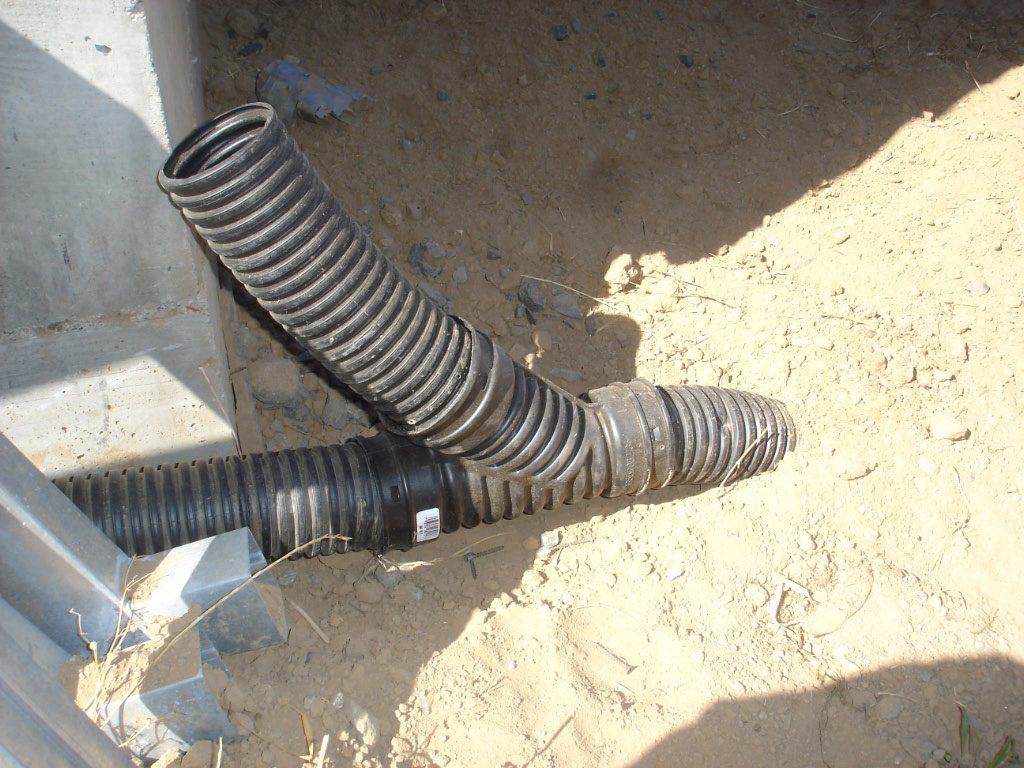
An underground downspout drain fixes that by catching the water at the bottom of each downspout and sending it through buried pipe. The setup usually starts with a downspout adapter that connects to solid, non-perforated pipe, often four-inch PVC or corrugated pipe with a smooth interior. The pipe is buried in a shallow trench with a steady downhill slope. It runs ten to thirty feet or more from the house, and then it ends at a pop-up emitter, a daylight outlet at a lower part of the lot, a catch basin, a dry well, or a connection to a storm system where the city allows it. Cleanouts at the base of each downspout let you flush leaves out later, and a grate or screen keeps debris from entering the line in the first place.
The word solid matters. A French drain uses perforated pipe because it is meant to collect groundwater along its length. A downspout drain does the opposite. It is meant to move roof water from point A to point B without leaking any of it back into the soil near your house. If perforated pipe is used by mistake, or if joints are left unglued and loose, the water you tried to send away seeps out beside the slab. For that reason, downspout drains use solid pipe with sealed or tightly fitted joints, and they are tested with a hose before the trench is covered. Ask any installer to show you the pipe type and the test before the trench is closed; it takes only a few minutes.
What to expect on a Wells Branch visit
- 01
Map the gutters and downspouts
We note every downspout, what roof area it serves, and where it lands now. Larger roof sections and valleys concentrate more water, so they get priority. We also check that gutters are clear and well pitched, because clogged gutters spill over the edge and send water to the foundation anyway, even when downspouts are piped away.
- 02
Pick the outlet first
The discharge point drives the whole design, so we choose it before laying out the pipe. We look for a lower part of your lot, an approved connection, a catch basin, or soil that can support a dry well. Rules vary by city and HOA, so any shared lot line, easement, or street connection is checked first.
- 03
Call 811 and lay out the route
Texas law requires a call to 811 at least two business days before digging, excluding weekends and holidays. Public utilities mark their lines at no charge. We paint the pipe route, steer around known irrigation lines and tree roots, and keep the path as straight as possible with gentle bends instead of tight corners.
- 04
Trench and set the pipe on a steady slope
Trenches are usually shallow, deep enough to protect the pipe from mowers, edging tools, and foot traffic. The bottom is graded so the pipe falls at least one-eighth inch per foot, often a quarter inch, so water and debris keep moving. Solid pipe is joined with proper fittings and connected to each downspout.
- 05
Add cleanouts and the outlet fitting
A small cleanout at the base of the downspout and at major turns lets leaves or roof grit be flushed out later. The pipe ends in the chosen outlet, such as a pop-up emitter that opens under flow and closes when dry, or a daylight spout with a rock apron to slow the water and prevent erosion.
- 06
Test with water and restore the lawn
Before we backfill, we run a hose into each downspout connection and watch the outlet and the joints. Any leak is fixed first. Then the trench is filled and compacted in layers, sod is replaced or reseeded, and the area is graded so no new low spot forms above the pipe. We also show you where each cleanout sits.
Our approach in Wells Branch
- We walk the property in Wells Branch and trace where water comes from, where it collects and where it can legally go
- We explain what we find in plain language, with photos where they help
- Repairs and installs are planned around Travis and Williamson Counties permitting requirements
- You get written options before any repair work begins
- We call 811 to mark buried utilities before any digging
Soil and drainage conditions around Wells Branch
Governance here is a little unusual. Wells Branch has long been served by a Municipal Utility District that funds parks, pools and trails, so the MUD may care about what happens in greenbelts and shared drainage areas. Depending on where your home sits, the county, the MUD and your HOA or condo association can each have a say over grading, fences and work near drainage channels. We could not verify specific permit rules for the area, so check with your MUD, the relevant county office and your HOA before regrading, building in a drainage easement or tying into a shared storm line. Texas Water Code Section 11.086 also prohibits diverting surface water in a way that damages a neighbor's property. Always call 811, since Texas law requires notice two business days before you dig, even in your own yard.
Underground Downspout Drains questions from Wells Branch homeowners
Can I tie my downspout drain into the street?
Often you can, but check first. The street, curb and right of way belong to a public entity, and the MUD, county or HOA may have rules about how water enters it. A neat, low-profile outlet is usually accepted. Call before cutting a curb or digging in the right of way. Ask the MUD whether any curb opening needs approval, since public curbs are not always open for new cuts.
What if my neighbor shares my gutter line?
Shared roofs mean shared water. Talk to the neighbor and the association, and agree on one route and one outlet. A written note of who pays and who maintains the drain avoids confusion. Water from your downspout cannot be aimed onto their property under Texas Water Code section 11.086. Written agreement with the neighbor and association avoids disputes if the pipe crosses common ground.
Do I still need gutters if I bury the downspouts?
Yes. Buried drains only work when gutters catch water and funnel it into them. Without gutters, the roof sheds water along its whole edge, and the drains do nothing. Keep gutters clean and tight, and replace sections that sag or leak before adding drainage. A quick check of gutter slope and hangers is worth doing at the same visit.
How long do underground downspout drains last?
Solid PVC pipe can last for decades when it is installed on a steady slope with sealed joints and kept clear. Weak points are usually the fittings, the emitter, and roots. A quick check each spring and fall to run a hose through the line and watch the outlet will catch most problems before they cause damage. Leaf season matters most.
How far from the house should downspout water be sent?
A common recommendation is at least four to six feet, and ten feet or more is better on clay soils that stay wet for a long time. Buried pipe makes longer distances practical. The right distance also depends on your lot size and slope, since the water needs a legal, safe place to land and cannot simply be pushed onto a neighbor.
Can I connect downspouts to a French drain?
In most cases, you should not. A French drain is built to collect groundwater through perforated pipe, and a sudden burst of roof water can overload it or push silt into the gravel. Downspouts should go on their own solid pipe to a separate outlet. Some designs do tie the two systems into one outlet downstream, but that needs careful planning. Ask for the design in writing.
More about underground downspout drains → · All services in Wells Branch →
Need underground downspout drains in Wells Branch?
Call or send a request. We will look at where the water goes, check the grade and give you a written estimate.