Pflugerville · Travis County
Dry Wells & Pop-Up Emitters in Pflugerville, TX
A dry well or pop-up emitter works where the pipe needs an outlet that does not touch a neighbor. Dense clay absorbs water slowly, so a dry well in Pflugerville must be sized with that in mind and often paired with an overflow path. Pop-up emitters release water at the surface through a spring-loaded cap and suit lots with enough room downhill. If a test shows the clay will not take the water, we change the plan rather than bury a pit that will just fill and sit.
Dry Wells & Pop-Up Emitters for Pflugerville homes
A dry well is a buried chamber or gravel-filled pit that holds roof or yard runoff and lets it soak into the ground. A pop-up emitter is a different tool, a capped fitting in the lawn that pops open under pressure and releases piped water onto the surface. In Pflugerville both come with a catch. The Blackland clay under much of the city is slowly permeable. A dry well that would drain in an hour in sandy soil can stay full for days in clay, so the design has to account for storage, not just infiltration. Rainfall in this part of Texas arrives in bursts, so a dry well sized for an average shower may be too small for a downpour of two or three inches.
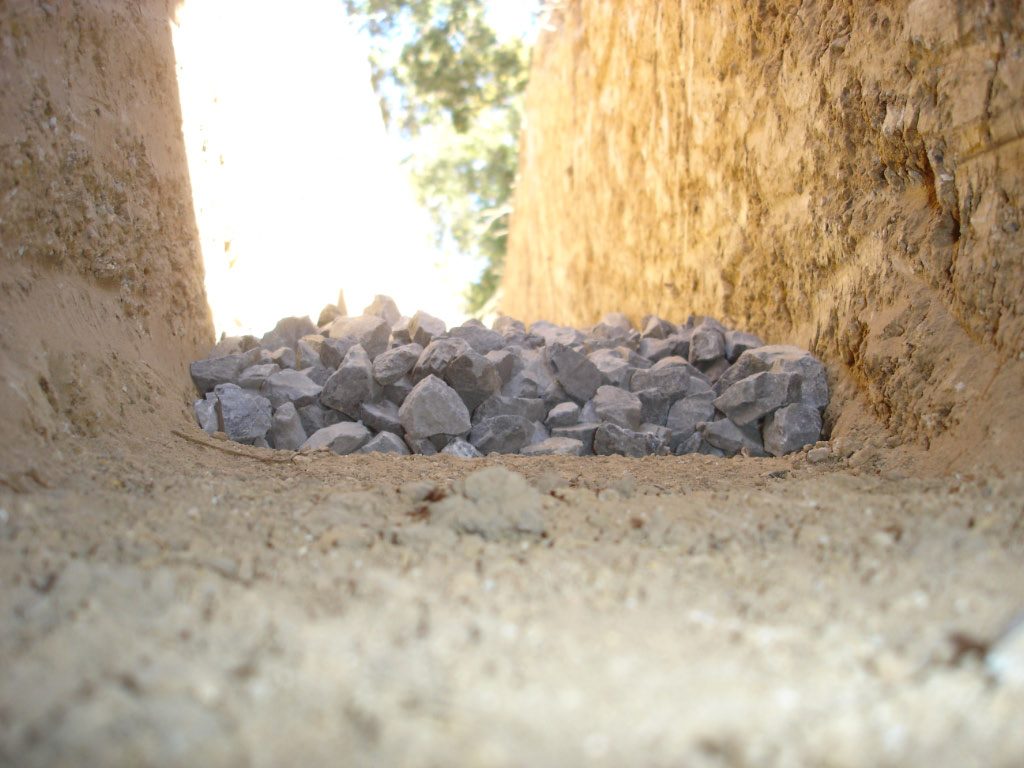
That is why a good dry well here is larger than it looks and almost always has an overflow. Think of it as a holding tank that empties slowly. Excavate a pit, line it with filter fabric, fill it with washed stone or set a perforated chamber in it, and run an overflow pipe to a safe exit. A simple soak test can reveal how fast your ground drains: dig a hole, fill it with water and time the drop. If water sits for more than a day, expect the dry well to rely on its overflow. Pop-up emitters suit the same lots, as long as the lawn has room to take the water. The overflow often matters more than the pit itself, since it is what protects the house when the chamber is full.
Placement rules matter. Keep a dry well well away from the foundation, a septic field, a well or a neighbor's property line. Underground utilities also limit where you can dig, and Texas law requires a call to 811 at least two business days before excavation. Check with the City of Pflugerville and your HOA about setbacks, and about whether a visible emitter in a front yard is acceptable. Emitters can erode bare soil, so we aim them onto grass or a splash pad and make sure the stream does not run toward a neighbor. Test the system during the first heavy rain. Watch where the emitter discharges and look for erosion, pooling or flow toward a fence line.
What to know in Pflugerville
Run a soak test first
Before sizing a dry well, dig a test hole and watch how fast it drains. In Pflugerville clay the results can be slow, and they change with the season. A slow test does not rule out a dry well, but it means plenty of storage and a safe overflow.
Always include an overflow
Clay fills a dry well, and after back-to-back storms the chamber can stay full. Without an overflow pipe, water backs up into the downspout line and the gutters. Run the overflow to a lawn emitter, a swale or a curb outlet that is legal for your lot.
Respect setbacks
Water pushed into the ground beside a slab can raise soil moisture against the foundation. Keep dry wells and emitters well away from the house, driveways and fences. Distance guidelines vary by city and HOA, so ask before you dig.
Signs you may need dry wells & pop-up emitters
- A downspout or drain pipe with no clear place to send its water
- Water pooling at the end of a pipe or splash block
- Eroded soil or a washed-out patch where a pipe discharges
- An existing dry well or pit that stays full for days after rain
How dry wells & pop-up emitters works
A dry well is a buried chamber that holds stormwater and lets it soak into the surrounding ground. Most residential versions are one of two types: a pit filled with washed gravel and wrapped in filter fabric, or a perforated plastic or concrete tank with open sides, set in a gravel bed. Pipe from a downspout, catch basin, or French drain feeds into the top. During a storm the well fills with water faster than the soil can absorb it, then empties over hours or days as the water seeps outward. It does not pump anything or use power. It only buys time, by storing a burst of runoff and letting the ground take it in at its own pace. Because the well is hidden, it is easy to forget, so note its location on a simple sketch of your yard.
A pop-up emitter works very differently. It is a small fitting, often with a hinged or spring-loaded cap, sitting flush with the lawn at the end of a buried pipe. When water flows through the pipe, pressure pushes the cap open and the water spills onto the surface. When the flow stops, the cap drops back and closes, which keeps out mowers, insects, and small animals. An emitter does not store anything, and it does not rely on soil absorption. Its job is to release water over a wide patch of lawn, which spreads the flow out and reduces erosion compared with a bare pipe end. It needs a slope that carries the water away from the house. Emitters are also easy to inspect, since you can see them and lift the cap to check for debris.
What to expect on a Pflugerville visit
- 01
Decide whether the soil can take it
We dig a test hole where the dry well would go, fill it with water, and time how fast it drops. Slow results in clay tell us a dry well will not drain, and we recommend an emitter or daylight outlet instead. This one step prevents the most common and costly dry well failures. Results are shared with you.
- 02
Choose the outlet type and location
Based on the soil, slope, and lot size, we pick a dry well, a pop-up emitter, or a combination. We place the outlet well inside your property, away from the foundation, septic components, and neighbors, and we plan a clear overflow route across your own lawn for very heavy storms. We mark the plan on a sketch for you.
- 03
Call 811 and mark the work area
Texas law requires a call to 811 at least two business days before digging, excluding weekends and holidays. Public utilities mark their lines for free. We also paint the pipe route and well location, and we check for private irrigation lines and tree roots that could change the layout. We also confirm how deep the line sits.
- 04
Excavate and build the structure
For a dry well, we dig the pit, line it with filter fabric, and set a perforated chamber or fill it with washed stone. For an emitter, we trench the pipe on a steady downhill slope and set the fitting flush with the lawn. All connections are sealed and bedded on compacted material.
- 05
Connect inflow and add overflow protection
Pipes from downspouts or drains enter the top of the well or the start of the emitter line. A dry well gets an overflow pipe or a surface path in case it fills. We add cleanouts and, where useful, a small silt-catching basin ahead of the well to protect it. Everything is labeled on the sketch.
- 06
Test, backfill, and explain the upkeep
We run water through the whole system, check the speed of the outlet, and watch for leaks. Then we backfill in layers, restore the lawn, and show you how to check the emitter cap, clear debris, and tell if a well is draining or staying full after storms. You get a simple sketch of the finished layout.
Our approach in Pflugerville
- We walk the property in Pflugerville and trace where water comes from, where it collects and where it can legally go
- We explain what we find in plain language, with photos where they help
- Repairs and installs are planned around Travis County permitting requirements
- You get written options before any repair work begins
- We call 811 to mark buried utilities before any digging
Soil and drainage conditions around Pflugerville
Water moves through Pflugerville along a handful of named creeks. Gilleland Creek begins northwest of town and runs about 27 miles to the Colorado River, and it was named for James Gilleland, an early settler. Wilbarger Creek rises north of town and drains east toward Bastrop County. Lake Pflugerville, the city's man-made lake, sits in the larger drainage network, and the city has built trails along the creek corridors. The terrain is gently rolling rather than steep, which sounds harmless until you remember that a few inches of fall across a whole subdivision sends sheet flow across many back yards before it reaches a ditch. Homes on the low side of a street, or backing onto a greenbelt or drainage easement, often receive the water that came off five or six lots uphill. Knowing which way your lot drains, and who is upstream, is the first real step in any fix. A fence line or raised bed can be enough to dam that sheet flow against a back wall.
Dry Wells & Pop-Up Emitters questions from Pflugerville homeowners
Do dry wells work in Pflugerville's clay soil?
They can, but only if designed for slow absorption. Clay drains slowly, so a dry well needs generous storage volume and an overflow route. Where the ground barely drains at all, a pop-up emitter or a curb outlet is often the better choice than a dry well that stays full. An engineer or experienced drainage contractor can read your soil test and size the system.
What is a pop-up emitter and how does it work?
It is a small fitting at the end of a buried pipe with a cap that stays closed in dry weather. When water pushes through the pipe, the cap lifts and releases the flow onto the lawn. When the water stops, the cap drops back down. It needs a grassy spot with room for the water to spread. Some models include a screen to keep debris and insects out of the pipe.
How far should a dry well be from my house?
There is no single number, because it depends on soil, roof area and local rules. A common approach is to place it well away from the slab, often 10 feet or more, and downhill of the house. Ask the City of Pflugerville and your HOA about setbacks before you choose a spot. Also avoid placing it in a path that carries a neighbor's runoff.
Does a dry well work in clay soil?
Usually not well. Heavy clay absorbs water very slowly, so a dry well can fill and stay full for days. Some lots have sandier layers or fractured limestone that accept water better. A percolation test in your own yard is the way to find out, and if the soil fails the test, a pop-up emitter or daylight outlet is usually the better choice. Ask for the test result in writing.
What is a pop-up emitter?
It is a small fitting at the end of a buried drain pipe, set flush with the lawn. Water pressure pushes the cap open during rain and lets the water spill out across the grass. When the flow stops, the cap falls shut. It works best on a lot with enough slope and open space to spread the water. Ask where the cap sits relative to the mower.
How far from my house should a dry well be?
Commonly at least ten feet, and farther on clay soils or small lots when possible. The well should also stay away from septic systems, private water wells, utility lines, and property lines. Local rules and the soil on your lot may set different requirements, so check with your city or HOA, and follow any recommendation from your installer. Ask your installer to mark the distance on the plan.
More about dry wells & pop-up emitters → · All services in Pflugerville →
Need dry wells & pop-up emitters in Pflugerville?
Call or send a request. We will look at where the water goes, check the grade and give you a written estimate.